Oakland Homelessness Falls Nearly 20 Percent
Published on May 19, 2026
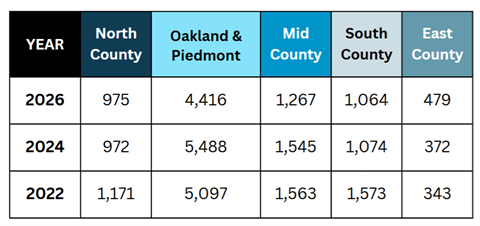
Oakland, CA – The 2026 Point-in-Time (PIT) Count released today by the Alameda County Housing and Health Department found that overall homelessness in Oakland has declined 19.6 percent since 2024, with “unsheltered homelessness” (the number of people sleeping outside, in vehicles, or in other places not meant for human habitation) falling from 3,659 to 2,695— a 27 percent decrease and a reduction of nearly 1,000 people as measured on a single night in January.
The PIT Count, which is the federally required biennial census of people experiencing homelessness, was conducted using the same methodology and timing as used in prior years, and Oakland had over 400 volunteers, the highest participation historically. Oakland's results reflect the combined impact of dedicated street outreach, increased interim and permanent housing capacity, faster placements between encampment response and shelter intake, and deeper operational coordination with Alameda County's health and housing systems.
"These numbers tell us what is possible when Oakland refuses to look away. Nearly one thousand fewer of our neighbors slept outside on a single night this year than two years ago. That is the measure of a city doing the work — and of partners willing to do it with us. This crisis does not respect city lines, and Oakland cannot solve it alone. We will keep leading, and we will keep asking our regional partners to lead with us," said Mayor Barbara Lee.
Oakland's progress is also beginning to improve the regional picture. While the city continues to account for 51.2 percent of Alameda County's unsheltered population and 53.8 percent of the total homeless count, both of those shares have declined since 2024 — meaning Oakland is not only reducing homelessness within its own borders, but is shrinking its disproportionate share of the regional crisis. Continued investment and continued coordination will allow Oakland's progress to keep pulling the regional numbers down with it.
"Progress at this scale is not the product of any single program. It is the result of hundreds of operational improvements — faster intake, tighter handoffs between outreach and shelter, sharper data flowing between the City and County in real time, and community partners focused on process improvements. My focus is making sure every part of that system runs better next year than it did this year, and that we are doing that work in close partnership with Alameda County and our regional partners. The data tells us what is working. Our job is to keep building on it," said Cupid Alexander, Chief Homelessness Solutions Officer.
"The decline in this year's PIT count is inseparable from the housing we are building. Oakland's Department of Housing and Community Development continues to advance one of the most active affordable and supportive housing production pipelines in the region, and that pipeline is what gives our outreach and shelter teams somewhere to send people — and somewhere for people to stay. Sustaining this progress will require all of us — City departments working in lockstep internally, and the City, County, and regional partners working in lockstep externally," said Betsy Lake, Acting City Administrator.
“We are excited to see the impact of the Oakland voter approved Measure U General Obligation Bond which, since the last PIT count, has helped bring online 630 affordable housing units, including 285 permanent supportive housing units,” said Emily Weinstein, Director of Housing and Community Development. "The increase in permanent housing with wraparound services for people exiting homelessness directly contributes to the City’s reduction in unsheltered homelessness."
The City is working with Alameda County, the Oakland Housing Authority and the State of California to scale up the City’s production of homeless units and is investing in the completion of over 1,400 affordable units over the next two years, including nearly 900 units of permanent supportive housing units for people exiting homelessness.
The City of Oakland is also the only City in Alameda County funding a targeted homeless prevention program, aimed at stemming the inflow into homelessness. Since 2024, in partnership with Keep People Housed, Oakland has ensured that every year, over 1,000 households most at risk of falling into homelessness are provided flexible financial assistance and services to help stabilize their housing. This helps stem the inflow into homelessness.
“Oakland’s work in connecting unsheltered individuals with transitional and permanent housing solutions goes hand-in-hand with the City’s commitment to local economic growth. Ensuring more stable lives for our residents directly translates into stronger, more vibrant commercial corridors where Oakland businesses can truly thrive,” said Ashleigh Kanat, Economic and Workforce Development Director.
Oakland's progress unfolds against the framework of the City's new Homelessness Strategic Action Plan, which sets a goal of reducing unsheltered homelessness by 50 percent over five years and organizes the City's work across five connected pillars: prevention, outreach, rapid diversion, interim housing, and permanent housing production. In the year ahead, the City will continue to expand its permanent supportive and deeply affordable housing pipeline, strengthen upstream prevention so fewer households ever enter homelessness, and drive operational efficiencies across the City's shelter and outreach portfolio so that every dollar moves more people, more quickly, into stable housing.
Oakland's Homelessness Strategic Action Plan is available at https://www.oaklandca.gov/Community/The-Unhoused-Community/Oaklands-Homelessness-Strategy
Point in Time Count Initial Results are available at: https://health.alamedacountyca.gov/data-and-reports/point-in-time-count/
###